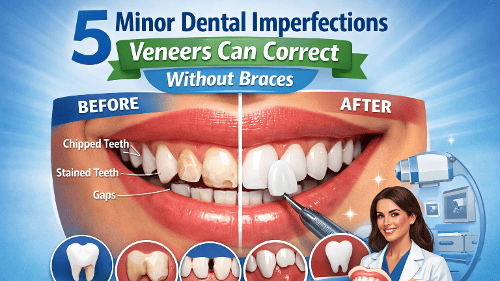
Braces and aligners have been the traditional method for straightening teeth and closing the gaps between them. However, recent advances in cosmetic dentistry have found new ways to straighten teeth without braces. Veneers can also improve minor misalignments and close small gaps quickly.
We’ll explore the cosmetic dentistry alternatives to braces and which option can deliver results suited to your needs
1. Closing Gaps With Veneers
Gapped teeth, also known as diastema, are common in dentistry and often bother patients seeking treatment. While some individuals don’t like the look of it, others find it problematic, such as causing food particles to become trapped and leading to cavities. Veneers for small gaps provide functional and aesthetic benefits for our patients.
For patients who don’t want lengthy orthodontic treatment, veneers offer a faster way to improve a gapped smile.
By placing and bonding a veneer over your tooth, it covers gaps on either side. We achieve this by reducing the size of your natural teeth to ensure a snug fit. There are a few considerations to keep in mind when choosing veneers to close gaps in teeth.
Veneer Material
Porcelain and composite veneers are effective in closing minor gaps between teeth. Porcelain veneers are known for their natural appearance, closely resembling tooth enamel. Composite veneers are ideal for patients who want a cost-effective solution.
Number of Veneers
The number of veneers required to close gaps varies among patients. Veneers may be applied to specific teeth to achieve uniformity, or an individual may require a comprehensive approach that includes multiple veneers.
Oral Care
Good daily oral hygiene and regular check-ups help veneers last longer.
2. Veneers for Alignment Issues
By reshaping your teeth, veneers can make crooked and uneven teeth appear straight. If you’re wondering if we can correct your misaligned teeth with veneers, consider the following:
For minor alignment issues, porcelain veneers may be a simple, effective cosmetic option when there is only mild to moderate crowding or spacing, and the bite is otherwise stable. You’ll also need healthy teeth and gums and realistic expectations, because veneers improve the appearance of misalignment but do not move the teeth themselves.
3. Uneven Tooth Size and Shape
Uneven teeth are a common concern for patients seeking a confident smile and better oral health. Whether caused by normal wear, trauma-related chips and cracks, or genetics, irregularly shaped teeth can impact your self-esteem. Porcelain veneers provide a transformative solution to symmetrical teeth without lengthy orthodontic treatment.
While uneven teeth are often seen as a cosmetic issue, they can also have structural implications. They may become increasingly difficult to clean, leading to plaque build-up and gum disease. Addressing these issues with veneers can enhance your appearance and support enhanced dental health.
4. Veneers for Minor Overlapping and Crowding
Malocclusion, or dental crowding, occurs when there’s insufficient room in your mouth for all your teeth to fit comfortably. Crowding can occur due to misaligned or overlapping teeth, teeth that are too large in proportion to the jaw, or over-retained milk teeth.
Dental veneers are a popular treatment for overlapping teeth. While they don’t reverse the effects, they can create the appearance of straight teeth. We invite you to schedule an appointment to see whether veneers for overlapping teeth are a suitable option for you.
5. Veneers for Bite Irregularities
Bite anomalies are typically the result of the misalignment of the upper and lower jaws. While many patients choose to correct this via braces, veneers provide an aesthetic solution and often enhance the efficiency of your teeth.
If you’re considering veneers for bite irregularities, there are two factors to consider:
- Underbite severity: Veneers are only effective for mild underbites.
- Severe underbites: Veneers may put additional stress on the teeth, which could lead to chips or cracks.
Reach out to us so we can assess the severity of your bite irregularity and choose an appropriate action plan.
FAQs – Veneers and Gaps
Are veneers a permanent solution for closing gaps?
We consider veneers a semi-permanent solution to gaps. With proper care, they can last for years, but they may need repairs or replacement. Veneers are a long-term commitment, so we will discuss your expectations before placement.
Do veneers look natural when used for quick smile correction in Tarzana?
When crafted and applied in our practice, we achieve a natural and seamless outcome. We customize the color and shape to match your teeth for a uniform finish.
Can veneers fix gaps caused by missing teeth?
We typically use veneers to address gaps between your existing teeth. Implants or bridges are suitable for replacing missing teeth and closing gaps.
How long will it take to see the results of veneers for gapped teeth?
The timeline of results depends on the complexity of each case and the number of veneers required. On average, patients can see their final results within a few weeks of the initial appointment.
Can I combine veneers with other cosmetic treatments to fix minor dental imperfections?
We can combine teeth whitening, gum contouring, or bonding for a comprehensive transformation. Our team tailors treatment plans for you to address multiple aesthetic concerns at once.
Benefits of Veneers vs Braces for Minor Imperfections
- Veneers offer a quicker, cosmetic solution without months of orthodontic work.
- Ideal for minor cases, veneers work best for slight crowding or spacing problems where the bite isn’t affected. Veneers without braces typically address minor issues, while individuals with more severe cases may require traditional braces.
Upgrade Your Smile With Cosmetic Veneers in Tarzana
We understand the importance of having a confident smile. Sometimes, even the most minor dental imperfection can undermine your self-assurance, affecting you in various settings. Many individuals don’t want to wait years for gaps to close or crooked teeth to straighten with braces.
Dental veneers for crooked teeth are a safe, efficient, and relatively quick solution to cover these imperfections. Our state-of-the-art studio caters to a multitude of dental needs that not only restore confidence but also repair function. Contact us to book your appointment today.